
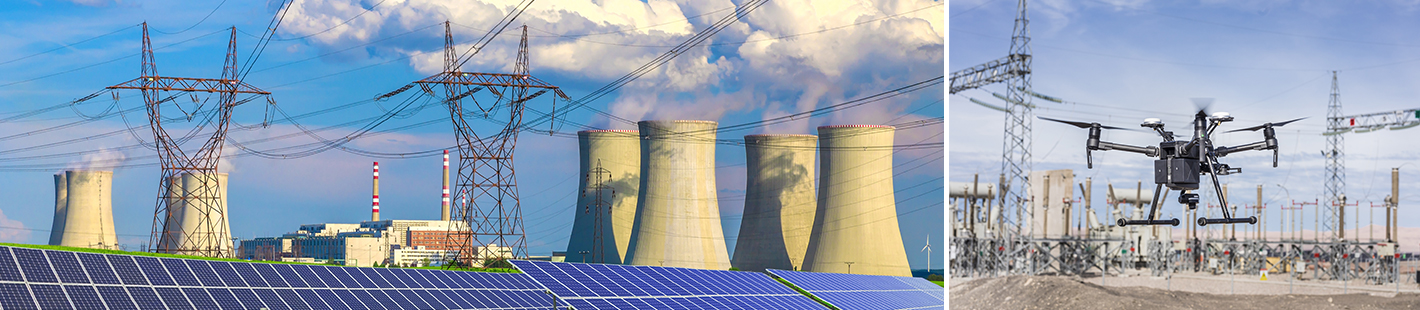
L’axe énergie et génie nucléaire regroupe plusieurs professeurs et chercheurs travaillant à l’application du génie physique à l’énergie, environnement et développement durable grâce à la neutronique, la thermohydraulique, la photovoltaïque et la thermoélectricité.
...Au sein de polytechnique Montréal
Pôle thématique : Énergie, environnement et développement durable
Depuis sa création, le département a développé une forte expertise en logiciels à destinaiton du nucléaire, dont plusieurs sont utilisés en industrie. Principalement, ils étudient et améliorent les modèles numériques de prévision du fonctionnement des réacteurs nucléaires. Pour l'exploitant d'une centrale nucléaire, la compréhension des techniques de simulations, ainsi que de leur domaine de validité, est essentielle aux activités courantes telles la gestion du combustible et les analyses de sûreté.
Informations sur nos installations:
- Laboratoire de thermohydraulique
- Laboratoire et réacteur SLOWPOKE
Ce logiciel de calcul de cellule et d'assemblage est utilisé pour résoudre l'équation de transport neutronique à l'aide de la méthode des probabilités de collision et par la méthode des caractéristiques. Il se compare avantageusement à plusieurs autres logiciels semblables utilisés à l'échelle internationale. Le code peut accéder à différents formats de bibliothèques de sections efficaces microscopiques.
Entièrement conçu ici, il possède des caractéristiques uniques telles que le traitement des géométries de supercellule en transport 3-D et une méthodologie très sophistiquée de prise en compte des fuites. De plus, il possède toutes les options nécessaires à la récupération de données nucléaires consistantes pour le calcul des réacteurs, que le pas du réseau de combustible soit carré ou hexagonal. Développé avec l'appui financier du CRSNG, de l'ÉACL, d'Hydro-Québec et de Polytechnique Montréal, le logiciel DRAGON est utilisé par plusieurs organismes de recherche partout dans le monde pour les études des réacteurs de puissance ou des réacteurs de recherche.
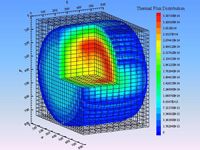 Ce logiciel permet le calcul du coeur du réacteur en utilisant le module TRIVAC pour résoudre l'équation de diffusion des neutrons par des méthodes d'éléments finis ou de différences finies. Ce module a d'ailleurs été intégré à différents logiciels de calcul de réacteurs comme HQ-SIMEX (logiciel de suivi du coeur développé à Hydro-Québec pour la gestion du combustible).
Le code DONJON inclut aussi le module NDF qui est utilisé pour résoudre l'équation de diffusion en utilisant des méthodes nodales. DONJON est un complément naturel à DRAGON et il permet d'effectuer de nombreuses analyses statiques des calculs de flux direct ou adjoint, des harmoniques et d'adjoints généralisés.
De plus, en se servant d'approximations quasistatiques (améliorée et généralisée), il permet aussi les études en cinétique espace-temps.
En vertu de l’alinéa 9b) de la Loi sur la sûreté et la réglementation nucléaires (LSRN), la Commission canadienne de sûreté nucléaire a le mandat d’informer objectivement à propos du nucléaire le public (sur les plans scientifique ou technique) et en ce qui concerne sa réglementation.
Dans le but d’améliorer le niveau de compréhension du public sur l’information disponible à propos des installations ou activités nucléaires proposées ou autorisées, les titulaires et les demandeurs de permis d’exploitation doivent élaborer et mettre en œuvre un programme d’information publique qui inclut un protocole de divulgation.
- Informations complètes sur le programme : site de la sûreté nucléaire
- Programme d'information et de divulgation publique des installations SLOWPOKE de Polytechnique Montréal (.pdf)
- Rapport annuel de conformité - installations SLOWPOKE de Polytechnique Montréal (.pdf)
- Installations SLOWPOKE sur le site de la sûreté nucléaire