

The MR 180 competition gives postdoctoral researchers the opportunity to present their research topics in simple terms to a diverse audience.
Each participant must give a clear, concise, and compelling 3-minute presentation on their research project. The goal is to convey your passion for your research while providing accurate and creative information.
2026 Edition
 2026 EDITION
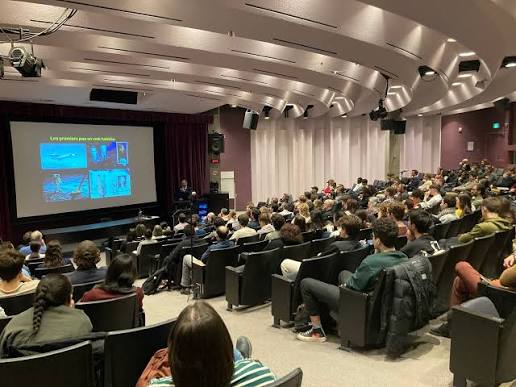
Thank you for cheering on the postdoctoral researchers who are ready to race against the clock to present their research in 180 seconds.
WINNERS OF THE COMPETITION
1st Award
Marek Zmeskal
Department: Mechanical Engineering
Research Supervisor: Professor Alain Hébert
Title of the Research: Protons for the Irradiation of Tumors
2nd Award
Nairouz Shehata
Department – Computer Engineering and Software Engineering
Research Advisor: Professor Hervé Lombaert Technical
Title of the Research: 4D Reconstruction of Aortic Wall Motion from 2D Cine MRI
3rd Award
Fatemeh Erfan
Department – Computer Engineering
Research Supervisor: Professor Martine Bellaiche
Title of the Research: Training AI on a Carbon Budget
Video & Photos
The presentations by the participants in the MR180 internal competitions can be viewed below.
Jury & Award
A jury composed of Polytechnique’s members of faculty and representatives from Quebec’s science media will select the winners of this internal competition.
Best Presentations Awards :
- 1st prize: $500
- 2nd prize: $250
- 3rd prize: $150
Dates to remember
- February 6, 2026: Deadline for submitting your text to stage.postdoc@polymtl.ca
- May 11th, 2026, Practice session in the Bernard Lamarre Auditorium (C-631)
- May 12, 2026: Internal competition in the Bernard Lamarre Auditorium (C-631)
Learn more
Relive the 2025 Competition
The MR180 competition requires a 3-minute presentation on your research topic. Here are some tips to help you.
Why Participate?
The competition requires time spent writing, numerous rehearsals, and a certain amount of risk-taking in front of an audience and a jury… so why participate?
Because those three minutes will always serve you well!
A Way to Develop Skills in Communication and Science Vulgarization
Participating in MR180 means, first and foremost, honing your communication skills by taking part in training sessions offered at Polytechnique Montréal. Effective communication isn’t something you’re born with, and it’s so important in a research career: writing compelling grant proposals, sharing your work with audiences interested in your results, and more.
A platform for national outreach
This competition is a fantastic way to showcase your project to the public and your peers.
Polytechnique Montréal promotes the winners.
What should you talk about for 3 minutes?
You must present your research topic and explain the concepts or ideas in accessible language (your mom should finally be able to understand what you're doing!).
Show your passion for your research topic.
You are allowed to use one non-animated slide to illustrate your points.
Eligibility criteria for the competition in french
- Be enrolled as a postdoctoral fellow at Polytechnique;
- Deliver the presentation in French;
- Demonstrate sufficient progress on the postdoctoral research project;
- Write a text of the presentation and send it to stage.postdoc@polymtl.ca one month before the start of the competition;
- Participants must agree to have their photo and the recording of their presentation made public.
Eligibility criteria for the competition in english
- Participants must deliver their presentations in English.
- Participants must be enrolled as postdoctoral researchers.
- Presentations must address the research topic that participants are exploring in their academic programs.
- Participants must agree to have their photos and recordings of their presentations made public.
Mentor
Thomas Gervais is a professor of engineering physics at Polytechnique Montréal since 2013. Thomas is also passionate about science communication, whether in writing, speaking, or on television. From 2006 to 2007, he worked as a science journalist for the daily newspaper La Presse and for Québec Science magazine. In 2008, he joined the team at Code Chastenay on Télé-Québec, where he worked as a reporter and science communicator from 2008 to 2013. During this period, he published over a hundred popular science articles, wrote and narrated 36 reports ranging from 6 to 12 minutes in length, and presented approximately sixty on-air segments with the Code team. He has received three awards for his journalistic work, including the Fernand Seguin Fellowship in 2006. At Polytechnique Montréal, he has hosted the “My Research in 180 Seconds” competition every year since 2012 and the MR180 since 2023 and is the co-founder, creator, and host of the “Génies en affaires” competition, organized this year for the fifth time by ACFAS.
Below you will find some general advice for preparing your MR180 and your summary. By following them, you will allow the team that supervises you to help you more quickly and more directly to improve your communication.
- Learn about past performances to help you develop your storytelling, you can watch some videos of former participants in the competition.
- Understand What Is Asked
In a MR180 presentation, it is about explaining your research to intelligent, interested people, but without any specific knowledge of your field. A good way to consider your audience is to imagine that they completed high school with a science major. Nothing more. You then need to find the right analogies, the required metaphors, and the appropriate tone to convey your story. Don't forget, the title says it, MR180, it's YOUR research in 180s.
Effective MR180 communications typically have certain key elements. Here is a non-exhaustive list that will inspire you.
Subject brought
A powerful introduction that captivates the audience while giving them the basic information to follow your research. A good intro is not too long (no more than 1 minute!) and allows you to quickly “set” the subject of your research. Good introductions can contain the following elements:
- An anecdote that illustrates the problems you face in your research.
- A great statistic showing the importance of your field of research
- A question that amuses the audience while stimulating their interest in knowing more
- Any other mechanism to capture the audience’s attention and make them want to know more.
Subject posed
An explicit description of your research topic. This typically includes a sentence starting with: “In my research work, my role is to…” or “The main goal of my research is to…”.
Subject divided
The concrete of your research. Often, postdocs only talk about their field of research and forget to give information about their daily research. However, this is very interesting for the public even if it is often routine for you.
- Providing juicy details about your day-to-day experience in research is very interesting. Examples: What do you do daily (reading, modeling on supercomputers, repetitive pipetting of colorless liquids in transparent containers). Be creative and stimulate the audience's imagination.
- Avoid jargon. Some words may be familiar to you but completely foreign to a very educated audience (cell lines, finite element method, analysis of variance, paradigm shift, etc.). If you use jargon or acronyms, you must take the time to define each term. This is a basic rule in popularization.
- Always speak in the first person. We know that your research would be nothing without your research director or the lab technician, but this is about showcasing YOUR research in 180 seconds. Postdocs often make the mistake of speaking in terms that are too general or impersonal while emphasizing facts and technical data. A MR180 is not a conference presentation. The human factor must be clearly apparent. The presentation must be informative but with a healthy dose of emotion.
Results
It is important to specify where you are and the kind of impact your work has had or will have on the public, on science, on the environment, etc.
A final drop
You must carefully compose the final sentence of your presentation. It must summarize your work and make the audience feel that your story is complete (and make them want to applaud at the end). To do this:
- Take elements from the introduction. This kind of punchline typically rounds out a story very well.
- Exit the scene with a catchy line or aphorism that sums up your entire point.
- Talk about your hopes for your project and its potential impact on society.
- Be positive, enthusiastic, and make the audience dream!
How to prepare your one-page presentation summary
Early in the process, you will be asked to submit a one-page summary of your presentation for validation and advice from the training team. This is a great opportunity for you to receive advice on how you present. For this process to be effective, your summary must be as similar as possible to the presentation you plan to give. Therefore, it is of little use to our team to receive a conference summary or other text that is poorly or not at all popularized. Instead, start writing your presentation as if it were a monologue in a theater. (A MR180s presentation takes up about 1 full page, single-spaced.) Try some analogies, popularization points, etc. This will make it easier for our team to understand your way of seeing your subject and to suggest areas for improvement or simply to positively reinforce the points that are already very good. Once you receive feedback, you will have time to revise your presentation before the dress rehearsal (point below) which typically takes place a week before the competition.
How to Prepare for the Dress Rehearsal
The dress rehearsal is a time when you can try out your entire presentation for the first time in front of a small audience (the other participants). It will be timed in the same way as during the competition. At the end, you will receive feedback from the mentor (often myself) and from the other participants. The more your text is practiced and ready, the more you will be able to receive constructive feedback from the audience. Therefore, it is imperative that you are very well prepared. Note sheets can help you if you are ever afraid of not having time to memorize your text.
Use of Humor in Presentations
Last thing. Humor is not mandatory in this kind of presentation, but people like to relax while learning. With a little humor, when appropriate, the subjects become less dry. Of course, avoid jokes on very serious topics (cancer, war, etc.). Use your judgment but remember that you also have the role of entertaining with your presentation.
Hoping that these few tips gleaned over 12 years of presenting MR180 are useful to you, I wish you good luck in your preparation.
