

Nouvelles
Polytechnique Montréal team contributes to a world first: direct observation in the human brain of an early marker of Parkinson’s disease
A group comprising scientist teams from the University of Cambridge, University College London (UCL), the Francis Crick Institute and Polytechnique Montréal has developed a revolutionary imaging technique that enabled them to accomplish a world first: the direct visualization in human brain tissue of a molecular mechanism underlying Parkinson’s disease. One member of the group compared the exploit, described in a recent article in the journal Nature Biomedical Engineering, to “being able to see stars in broad daylight.”
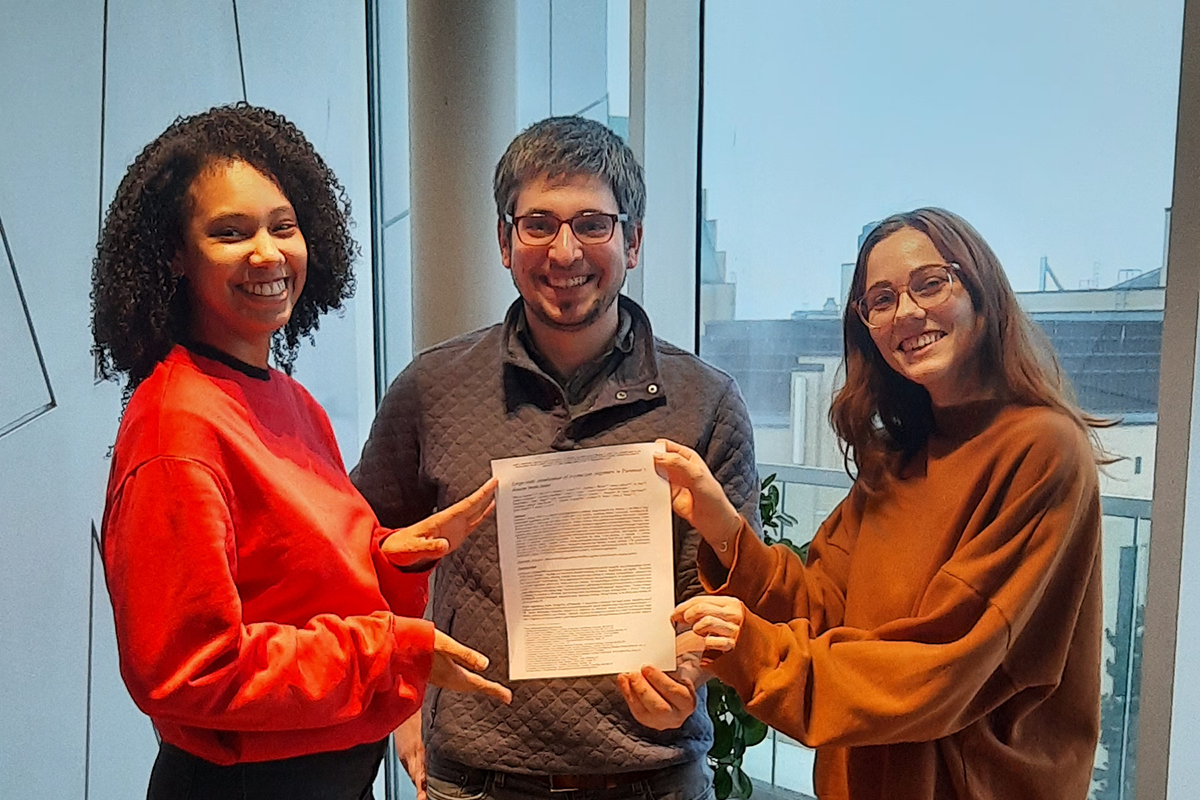
L. to r.: Kenza Baspin, BE in engineering physics (Po 2024); Lucien Weiss, Associate Professor in the Department of Engineering Physics; Angèle Deconfin, BE in biomedical engineering (Po 2024).
Many of us have lived our whole lives without ever coming across the name of a protein that is found in large quantities in our brains: alpha-synuclein (α-synuclein). This may not be true, however, for people living with Parkinson’s disease and those close to them: the protein tops the list of potential suspects responsible for the early stages of the disease.
Although thousands of articles have been published about alpha-synuclein, the precise role it plays in the synapses that connect our neurons remains undetermined. One thing that scientists do know, however, is that large aggregates of the protein are found in the brains of people who have died from Parkinson’s. In fact, the presence of alpha-synuclein is how physicians have identified the disease during autopsies for more than a century.
Some specialists have noted, however, that these large aggregates—known as Lewy bodies—tend to be detected late. This suggests they are a consequence of Parkinson’s, not an early indicator of its development. Other researchers, though, suspect that smaller aggregates of alpha-synuclein are the cause of Parkinson’s, damaging cells many years before the onset of the earliest symptoms of the disease. The problem is that until now, no tool existed to allow researchers to test that hypothesis. It was impossible to distinguish these nanometre-scale smaller alpha-synuclein aggregates from the cellular “background noise,” spurious signals and the signals of healthy alpha-synuclein proteins.
As Dr. Rebecca Andrews, co–first author of the article—who was a postdoctoral fellow at the University of Cambridge when the research was conducted—told the British media, it was somewhat like trying to “see stars in broad daylight.” The international research group, which included a team led by Dr. Lucien Weiss, Associate Professor of engineering physics at Polytechnique Montréal, developed a solution to the problem. Their technique provided a way of distinguishing between the two states of the tiny protein, shedding new light on how Parkinson’s disease develops—just as if it were possible to see the light of stars in a sunny sky.

Alpha-synuclein aggregates (in yellow) are visualized inside microglia (immune cells in the brain). The existence of these structures at early stages of Parkinson’s disease was hypothetical until now. The theory has been verified thanks to the work of the international research team. (Photo: Lucien Weiss)
A helping hand from Montréal
The research group developed an imaging technique, Advanced Sensing of Aggregates for Parkinson’s Disease (ASA-PD), that makes it possible to visualize, count and compare the protein aggregates in human brain tissue. The method is detailed in this article published in the journal Nature Biomedical Engineering.
The new imaging technique reveals aggregates at the nanometre scale (a nanometre is one billionth of a metre, which is 100,000 times thinner than a human hair). It relies on ultrasensitive fluorescence microscopy, which was used to detect and analyze millions of aggregates in post-mortem brain tissue. Given the aggregates’ minuscule size, detecting their signals had been difficult until now. The ASA-PD method maximizes those signals while suppressing background “noise” in the images, improving detection sensitivity to the point that individual aggregates of alpha-synuclein can be visualized and studied.
One key to the success of the project was the expertise of Professor Weiss and two Polytechnique Montréal interns, Kenza Baspin, who earned her bachelor’s degree in engineering physics in 2024, and Angèle Deconfin, who graduated in biomedical engineering the same year.
The research began in 2021, Professor Weiss recalls: “After completing postdoctoral work, I had gone to Cambridge in April 2021 to work on this project. At the same time, though, I received an offer for my dream position as a professor at Polytechnique, so I headed to Canada that summer.”
The international collaboration presented an opportunity for two of Professor Weiss’s early recruits to contribute to the project, which included taking part in weekly group meetings with their European colleagues. Ms. Deconfin also had the chance to spend a summer in Cambridge in person, collecting data, while Ms. Baspin focused on enhancing the algorithms used to optimize the tool’s sensitivity.
“A novel analytical capability like this one requires a lot of validation,” Professor Weiss adds. “To be certain of correctly quantifying nanometre-scale aggregates, we had to develop a new set of algorithmic tools. Angèle and Kenza helped in constructing a reliable annotated dataset that was used to design and adjust the algorithm as well as evaluate its performance. Then we developed a set of meta-analysis tools to help sort the massive library of data collected.”
The tool enabled comparison of brain tissue samples gathered during autopsies of deceased Parkinson’s patients with the brains of healthy individuals of similar age. Small alpha-synuclein aggregates were found in both populations, but with a significant difference: in images from people who had the disease, the aggregates were larger and brighter, and there were more of them. This suggests a direct link to the progression of Parkinson’s disease.
The researchers also discovered a subclass of aggregates that are visible only in people with Parkinson’s. They may be among the earliest visible markers of the disease, possibly present years before the onset of symptoms.
Moreover, as Professor Weiss notes, the approach may hold clues for researchers investigating other neurodegenerative conditions: “This method doesn’t just give us a snapshot. It offers a whole atlas of protein changes across the brain, and similar technologies could be applied to other neurodegenerative diseases like Alzheimer’s and Huntington’s.”
Learn more
Professor Lucien Weiss’s expertise
Department of Engineering Physics website
Large-scale visualization of α-synuclein oligomers in Parkinson’s disease brain tissue, article published on October 2 in Nature Biomedical Engineering

