

Materials, Chemical process, Water treatment
Unmet need
Despite being the second most abundant biopolymer and a major byproduct of the pulp and paper industry, lignin remains significantly underutilized, predominantly burned for heat recovery rather than transformed into value-added high-performance materials.
Concurrently, the wastewater treatment sector faces increasing economic and environmental pressure to replace conventional inorganic coagulants and synthetic flocculants, such as aluminum sulfate and polyacrylamide, which are associated with high operational costs, toxicity, corrosiveness, and reliance on dwindling petrochemical resources. Although lignin presents a promising biodegradable alternative, its native form lacks the requisite molecular weight and chemistry to be used directly as a coagulant or flocculant agent for effective water treatment. Furthermore, traditional chemical modification techniques aimed at enhancing its properties, such as grafting, are typically energy-intensive, time-consuming, and reliant on adding extra harsh chemicals to create new functional groups, thereby creating substantial barriers to industrial scalability and sustainable implementation. There is a need for innovative solutions that can match or surpass the performance of conventional chemical agents while minimizing environmental impacts.
Technology overview
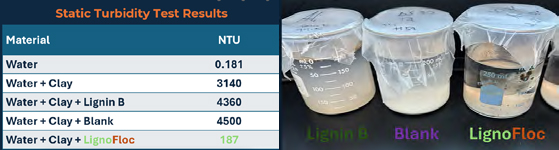
This technology introduces a continuous process that converts softwood kraft lignin into a high-performance, multifunctional agent for water and wastewater treatment. The resulting enables efficient aggregation and removal of suspended particles in water treatment applications from water. The results demonstrate strong performance, including -significant reductions in turbidity removal rate in model suspensions. Unlike conventional treatment chemical agents, which typically require separate inorganic salts and synthetic polymers, this approach provides a novel high-value utilization direction for biomass lignin.
This approach provides a single multifunctional biodegradable agent derived from a renewable resource. The continuous process is rapid, energy-efficient, and scalable, avoiding the lengthy, energy-intensive, and chemically harsh grafting methods traditionally used to modify lignin. By combining sustainability, efficiency, and dual functionality, the technology offers a promising alternative to conventional petrochemical-based water treatment agents.
Market applications
- Industrial & Mining Effluent Management
- Municipal Water & Wastewater Treatment Plants
Competitive advantage
- Sustainable and safer alternative to conventional chemicals
- Scalable, fast and cost-efficient production
- Dual function: acts as both coagulant and flocculant
- Valorizes low-cost lignin waste into high-margin specialty chemicals for a circular economy
Business opportunity
- Sustainable and safer alternative to conventional chemicals
- Scalable, fast and cost-efficient production
- Dual function: acts as both coagulant and flocculant
- Valorizes low-cost lignin waste into high-margin specialty chemicals for a circular economy

Pr. Daria Boffito
Full professor
Department of Chemical Engineering
Expertise
Sarah Nahlé
Technology Transfer Manager
