


Coarse granular materials are widely used in civil engineering applications such as rockfill dams, railway ballast, and mine waste rock. However, the characterization of their mechanical properties typically requires large-scale laboratory or in-situ testing, which is labor-intensive, time-consuming, and costly. As a result, practitioners often rely on design parameters derived from a limited number of experimental studies.

In this context, our work has focused on the development and application of large-scale laboratory and in-situ testing methodologies for coarse granular materials. The main objectives are to assess scale effects, expand the available experimental database, and establish robust scaling laws that enable reliable interpretation of tests performed on reduced-size samples.
Funding SOURCES:
- NSERC, Canada. "Multi-scale testing and modeling particle size effects on primary and secondary compressibility of crushable granular materials".
- FRQNT, Quebec, Canada. « Développement de critères hydrogéotechniques et opérationnels pour améliorer la stabilité à long terme des haldes de roches stériles et des ouvrages miniers mettant en valeur les stériles ».
- Research Institute on Mines and the Environment (RIME) UQAT-Polytechnique.
Featured publications:
- Girumugisha, Ovalle, Reith, Stutz (2026). Effects of Triaxial Sample Scaling on the mechanical behavior of alluvial gravels. Journal of Geotechnical and Geoenvironmental Engineering, 152(1), 04025166
- Girumugisha, Ovalle (2026). End restraint effects in triaxial tests on H:D=2:1 specimens of rockfill material. Géotechnique Letters, https://doi.org/10.1680/jgele.25.00009
- Osses, Pineda, Ovalle, Linero, Sáez (2024): Scale and suction effects on compressibility and time-dependent deformation of mine waste rock material. Engineering Geology 340, 107668
- Girumugisha, Ovalle, Ouellet (2024). Grading scalping and sample size effects on critical shear strength of mine waste rock through laboratory and in-situ testing. International Journal of Rock Mechanics and Mining Sciences 83, 105915
- Aubertin, Maknoon, Ovalle (2021): Waste rock pile design considerations to promote geotechnical and geochemical stability. Canadian Geotechnique 2(3), pp. 44-47
- Ovalle, Linero et al. (2020): Journal of Geotechnical and Geoenvironmental Engineering 146(9): 06020013
- Ovalle & Dano (2020). Géotechnique Letters 10(2), pp. 191-197
- Ovalle et al. (2014). Acta Mechanica 225: 2199–2216


In order to propose physical based small-scaling laws for coarse materials, we focus our analyses on the micro-structural sources of the mechanisms governing the response of granular media, using discrete modeling and multiscale analytical methods based on individual rock aggregates characteristics.
Funding SOURCES
|
|
Featured publications
|
   |
 Mine waste rock and dam rockfill materials typically have wide particle size distribution (psd), with a large variety of angular particle shapes, and containing very coarse clasts that could easily reach more than 1 m in size. Small scaling techniques for mechanical testing on such coarse materials require altering the psd, by reducing maximum particle size to be able to fit a sample in a laboratory device.
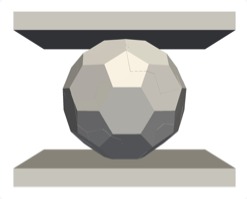
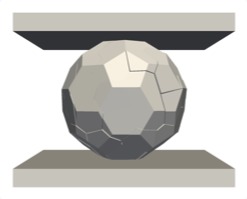
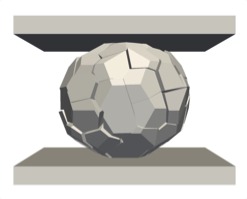
 Mechanical degradation due to grain crushing can be found in several geoengineering and geological problems, such as high rockfill dams, mine waste dumps, pile penetration in sands, fault gauges deformation, formation of glacial till, subsidence of fractured rock deposits, etc.
We study this topic by working in experimental testing, numerical discrete simulations, and constitutive modeling. A multiscale approach allows us to consider the effects of grain charactaristics (particle size-shape-strength correlations), and state properties as humidity and its influence on the Stress Corrosion Cracking process causing delayed events of particle fragmentation and creep deformation.
Funding SOURCES:
- FONDECYT - Conicyt, Chile
- NSERC, Canada. "Multi-scale testing and modeling particle size effects on primary and secondary compressibility of crushable granular materials".
Featured publications:
- Osses, Pineda, Ovalle, Linero, Sáez (2024) Engineering Geology (DOI: 10.1016/j.enggeo.2024.107668)
- Osses, Majdanishabestari, Ovalle, Pineda (2021). Soils and Foundations (DOI: 10.1016/j.sandf.2021.09.006)
- Ovalle & Hicher (2020). Geosciences Frontiers 11(2):487-494 (DOI: 10.1016/j.gsf.2019.06.009)
- Osses et al. (2019). Geo St. John's 2019, September 29 to October 2, 2019
- Osses et al. (2019). Japanese Geotechnical Society Special Publication 7(2): 335-339 (DOI: 10.3208/jgssp.v07.054)
- Ovalle (2018): Géotechnique Letters 8(2):161-164 (DOI: 10.1680/jgele.18.00047)


 Segregation and stratification pose challenges for the design of mine waste rock piles. The heterogeneity of the dumped material could induce potential development of weak alternating layers, or preferential drainage paths that could affect remediation and control of acid mine drainage.
Many physical tests have been reported in the literature, however, an accurate DEM model to predict segregation and stratification is still missing. With the aim of studying the physics of the phenomenon, we perform 2D and 3D DEM simulations pouring samples of size-dispersed and shape-dispersed grains to build granular deposits.
Funding SOURCES:
- FRQNT, Quebec, Canada. « Développement de critères hydrogéotechniques et opérationnels pour améliorer la stabilité à long terme des haldes de roches stériles et des ouvrages miniers mettant en valeur les stériles ».
- Compute Canada. "DEM virtual laboratory for geomaterials and environment".
- Research Institute on Mines and the Environment (RIME) UQAT-Polytechnique.
Featured publications:
- Vuilloz, Cantor, Ovalle (2021): Segregation and stratification in pouring heaps of bi-dispersed mixtures of rounded particles. Powders & Grains 2021, Buenos Aires, Argentina.
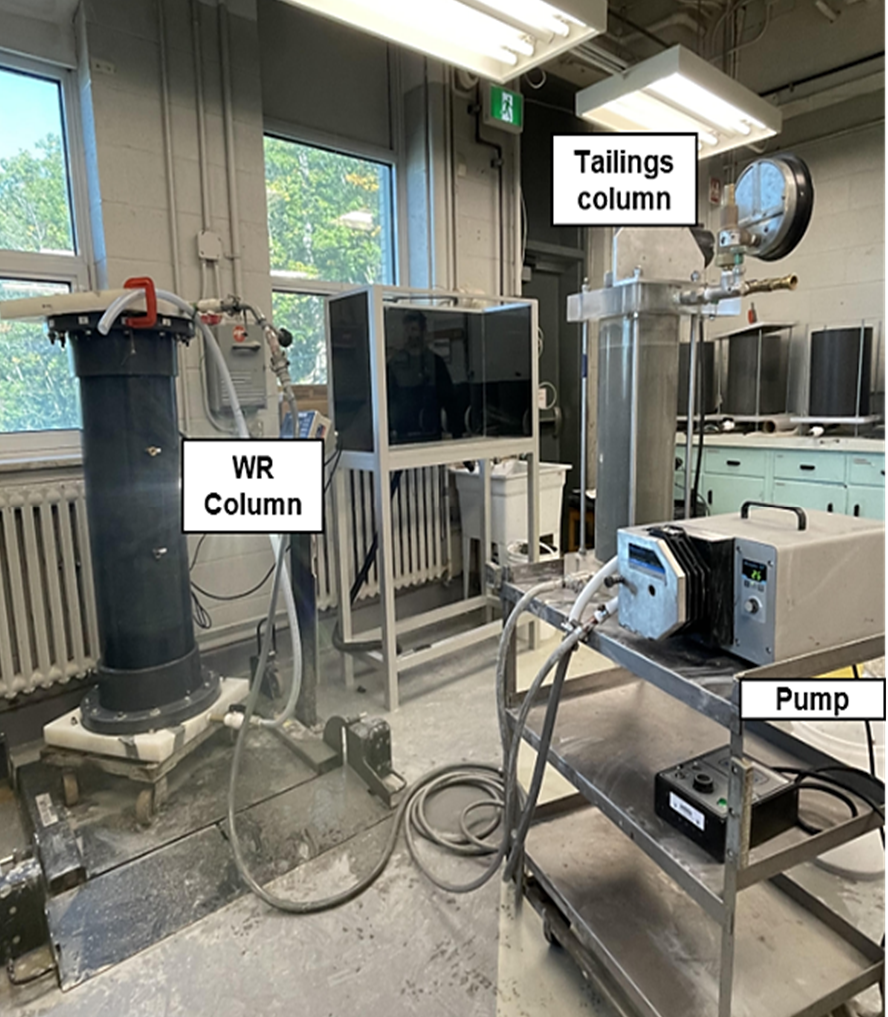

We work on geotechnical characterisation of tailings and co-disposal methods of tailings and waste rock, including large consolidation properties, static liquefaction, cyclic and dynamic behavior.
Funding SOURCES:
- Mitacs (Canada), SRK Consulting Vancouver, Minera Penoles (Mexico). "A multi-scale approach to study the effect of fines content and particle shape on static liquefaction potential of loose mine tailings".
- Mitacs, Mine Canadian Malartic. "Hydrogeotechnical behaviour and physical stability of the co-placement of waste rock and mine tailings in Canadian Malartic open pit".
- Research Institute on Mines and the Environment (RIME) UQAT-Polytechnique.
- NSERC, Canada. "Multi-scale testing and modeling particle size effects on primary and secondary compressibility of crushable granular materials".
Featured publications:
-
Behlke, F., Ovalle, C., Li, L. (2025): Experimental investigation of mine tailings migration through waste rock in co-disposal structures. Tailings and Mine Waste 2025, November 2-5, Banff, Alberta, Canada
-
Jalalichi, Z., Ovalle, C., Ouellet, S. (2025): Back analysis of the geotechnical stability of high waste rock piles: monitoring, testing and modeling. Tailings and Mine Waste 2025, November 2-5, Banff, Alberta, Canada
-
Behlke, F., Ovalle, C., Ouellet, S., Li, L. (2025): Évaluation de la migration des résidus et du comportement hydrogéologique du remblayage par co-déposition dans la fosse de la mine Canadian Malartic. Symposium Mines et environnement 2025, Rouyn-Noranda, Québec, Canada, 8-11 juin 2025.
- Behlke, F., Ovalle, C., Li, L. (2024): Experimental investigation of drainage and consolidation of tailings slurry in a co-disposal structure. Annual conference of the Canadian Geotechnical Society, GeoMontréal 2024, September 15-18, Montreal, Canada.
- Garcia-Torres, Behlke, Ovalle, Ouellet (2023): Effect of tailings migration on hydraulic conductivity of mine waste rock. Annual conference of the Canadian Geotechnical Society, Geosaskatoon 2023, October 1-4.
- Ouellet, Chapuis & Ovalle (2021) : Le projet de co-déposition dans la fosse Canadian Malartic. Symposium Rouyn-Noranda 2021 sur l’environnement et les mines (UQAT)
- Reid et al. (2020): Results of a critical state line testing round robin program. Géotechnique (DOI: 10.1680/jgeot.19.P.373)
- Edwards et al. (2018) Exposure of Chilean Tailings to Earthquake Hazards from Potentially Seismogenic Crustal Faults. 2018 Seismology of the Americas Meeting, Miami, Florida. SRL 89(2B): 826
- Urbano et al. (2017): Monotonic and cyclic behavior of thickened copper tailings. 19th ICSMGE), Seoul, Republic of Korea.
- Urbano et al. (2017): Numerical Modeling of the Monotonic Performance and Cyclic of Thickened Tailings in A Wide Range of Deformation. Tailings 2017, 4th International Seminar on Tailings Management, Santiago, Chile


