
Nouvelles
At ALL IN, Polytechnique Montréal launched the AI for the Real World initiative and now calls on an entire ecosystem to collaborate

(Photo : Mélanie Olmstead)
For many years, Polytechnique Montréal and artificial intelligence research and development have maintained close ties. Indeed, our university is a founding member of several key pillars of Québec’s AI world and digital ecosystem. We are a long-standing partner of Mila, a co-founder of IVADO, and, alongside Université de Montréal and HEC Montréal, an initiator of the Multidisciplinary Institute for Cybersecurity and Cyber Resilience (IMC²);
On September 16 and 17, Polytechnique took part for the first time in ALL IN, Canada’s largest AI event, which brought together more than 10,000 participants from 50 countries, including some of the most influential leaders from Canada’s and the world’s AI ecosystems. During our participation in the event, our engineering university made its voice heard and demonstrated the leading position it occupies within the AI landscape.
Foutse Khomh takes the stage and unveils the AI for the Real World initiative
On the event’s opening day, Foutse Khomh, Polytechnique Montréal's Vice President of Research and Innovation, took the stage to present a new vision for artificial intelligence research at our university.
“How can we transform artificial intelligence into a technology capable of delivering lasting improvements in the real world?” he asked in front of a full and attentive audience. This is precisely where Polytechnique has a unique role to play: we aim to design and deploy AI as a complete engineering system capable of operating reliably and sustainably in real-world environments.
AI for the Real World is a new approach to AI that goes way beyond model performance. It encompasses the entire lifecycle of AI systems, from design, testing, validation, and integration to deployment. The initiative is built around three strategic action areas:
- Bringing AI into the physical world;
- Transforming engineering practices through AI;
- Developing new computing architectures for AI.
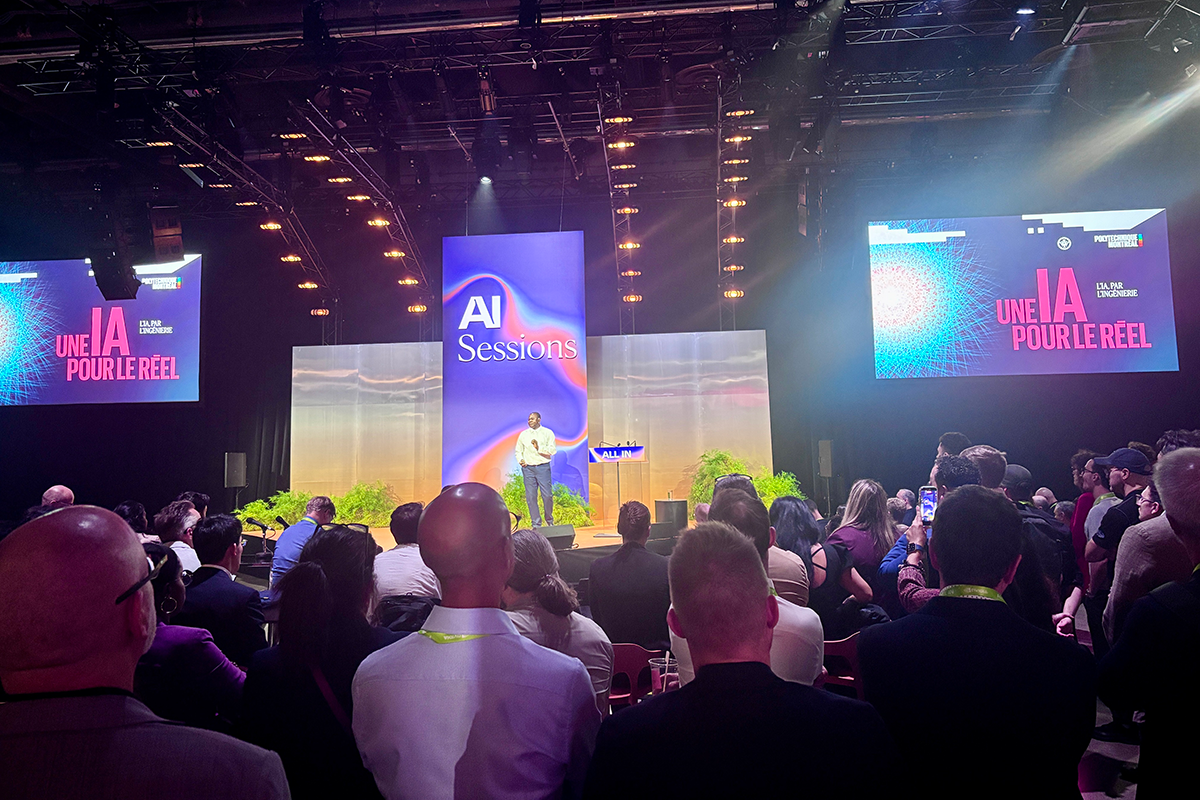
Foutse Khomh on the AI Sessions Stage.
In closing his presentation, Foutse Khomh issued a call to collaborate across the broader ecosystem, emphasizing that “such an ambition cannot be carried by a single institution alone.” Researchers, research teams, and projects at Polytechnique, as well as those that exist within businesses, governments, industry partners, students, and engineers, are all invited to contribute to the next revolution in AI.
Video: ALL IN Canada
Showcasing Polytechnique Montréal’s unique expertise
At Polytechnique, AI spans every major field of engineering, including aerospace, biomedical, civil, chemical, electrical, computing, software, and mechanical engineering. It also intersects with photonics, advanced materials, quantum technologies, and cybersecurity.
This expertise is reflected in a thriving research ecosystem: 46 faculty members are actively engaged in AI research, 11 research chairs are connected to the field, 16 laboratories and research units conduct AI-related activities, and nearly 200 collaborations and 80 partnerships are currently active within our institution. As Foutse Khomh stated on stage, “At Polytechnique Montréal, this revolution is already underway.”
Throughout the two-day event, our experts showcased their AI research at the Polytechnique booth, engaging with the many visitors who stopped by. Their presentations shed light on critical issues at a time when ethical and environmental concerns surrounding AI occupy an increasingly prominent place in the public discourse.
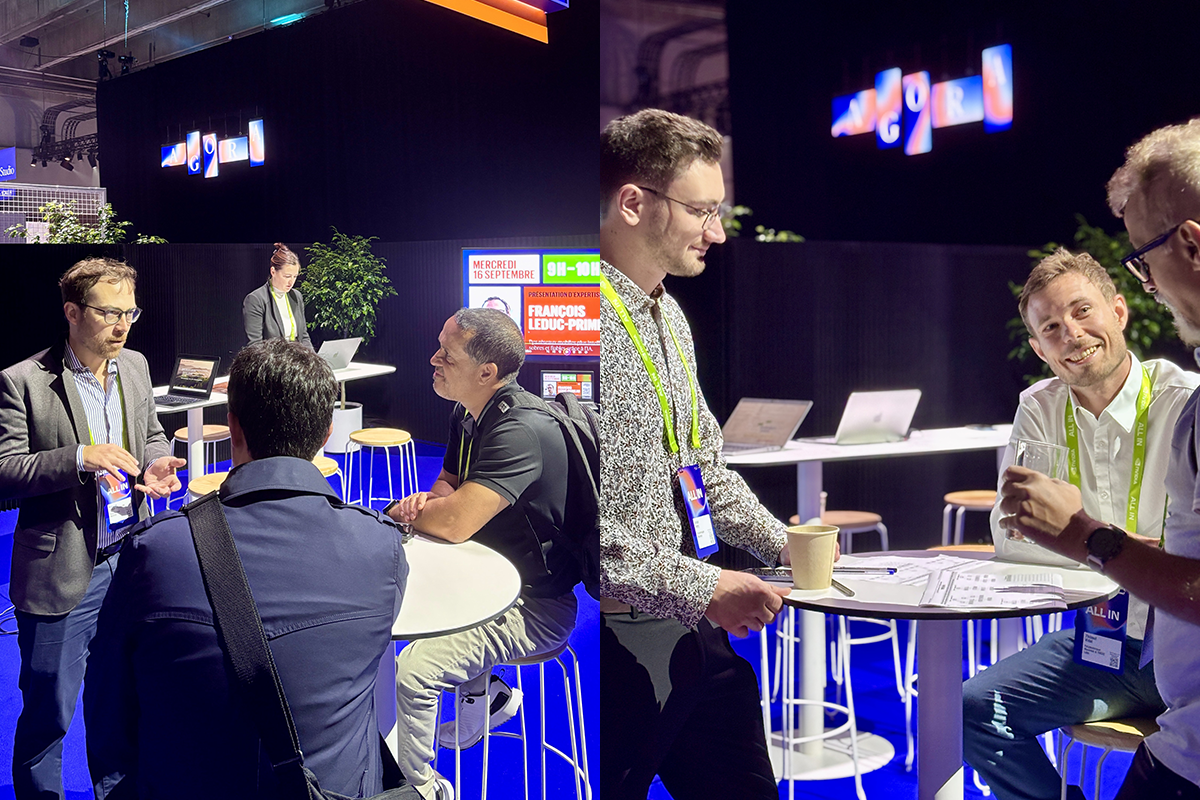
On the morning of September 16, François Leduc-Primeau, Associate Professor in the Department of Electrical Engineering of Polytechnique (left picture), presented his work on AI for communication systems and efficient, reliable hardware acceleration.
Later, Thibaut Vidal, Full Professor at our Department of Mathematics and Industrial Engineering, and Julien Ferry, Postdoctoral Researcher (pictured on the right), discussed trustworthy AI, data privacy, and decision-focused learning with booth visitors.
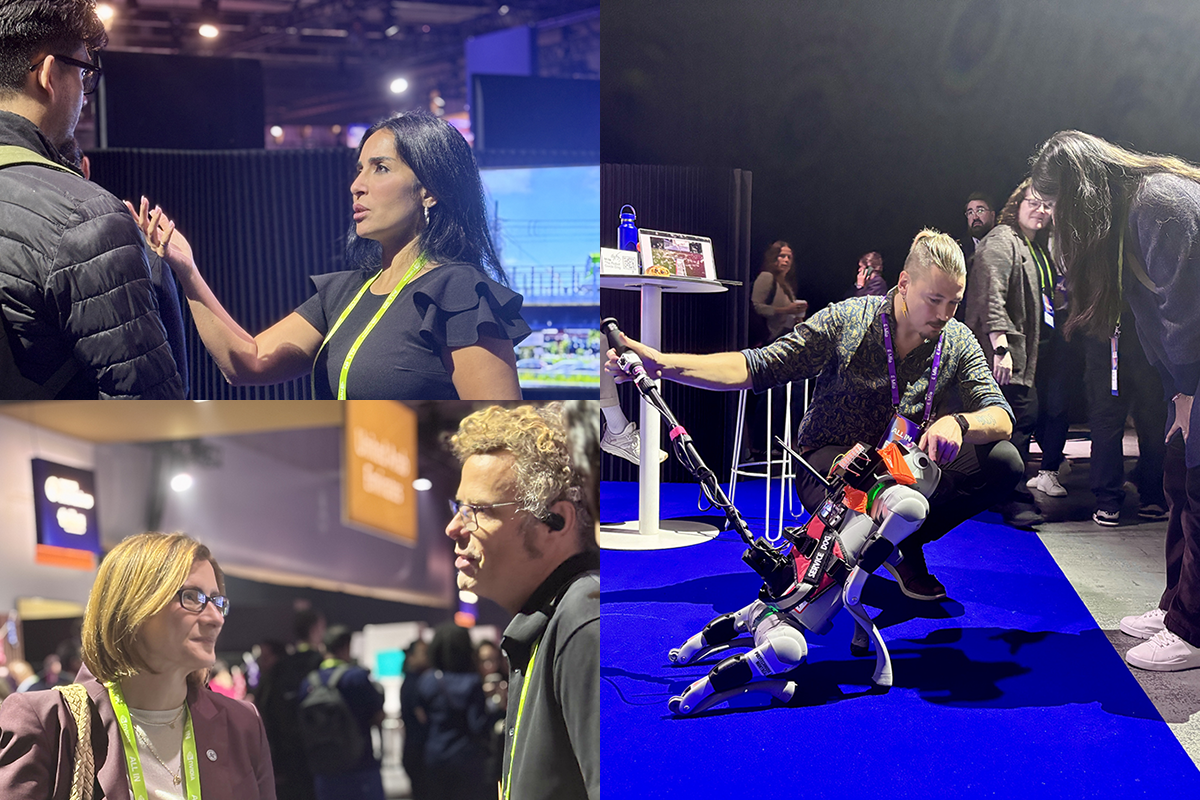
On the afternoon of September 16, Ranwa Al Mallah, Associate Professor at our Department of Computer and Software Engineering (top left picture), addressed a wide range of topics including AI cybersecurity, privacy in agentic systems, and the auditing of large language models.
Also present at the event were Christopher J. Pal, Full Professor at our Department of Computer and Software Engineering (bottom left picture, alongside Polytechnique Montréal's President Maud Cohen) and Florian Golemo, a Mila research associate. Together, they presented Milo, an autonomous guide dog designed to assist people who are blind or partially sighted (right picture).
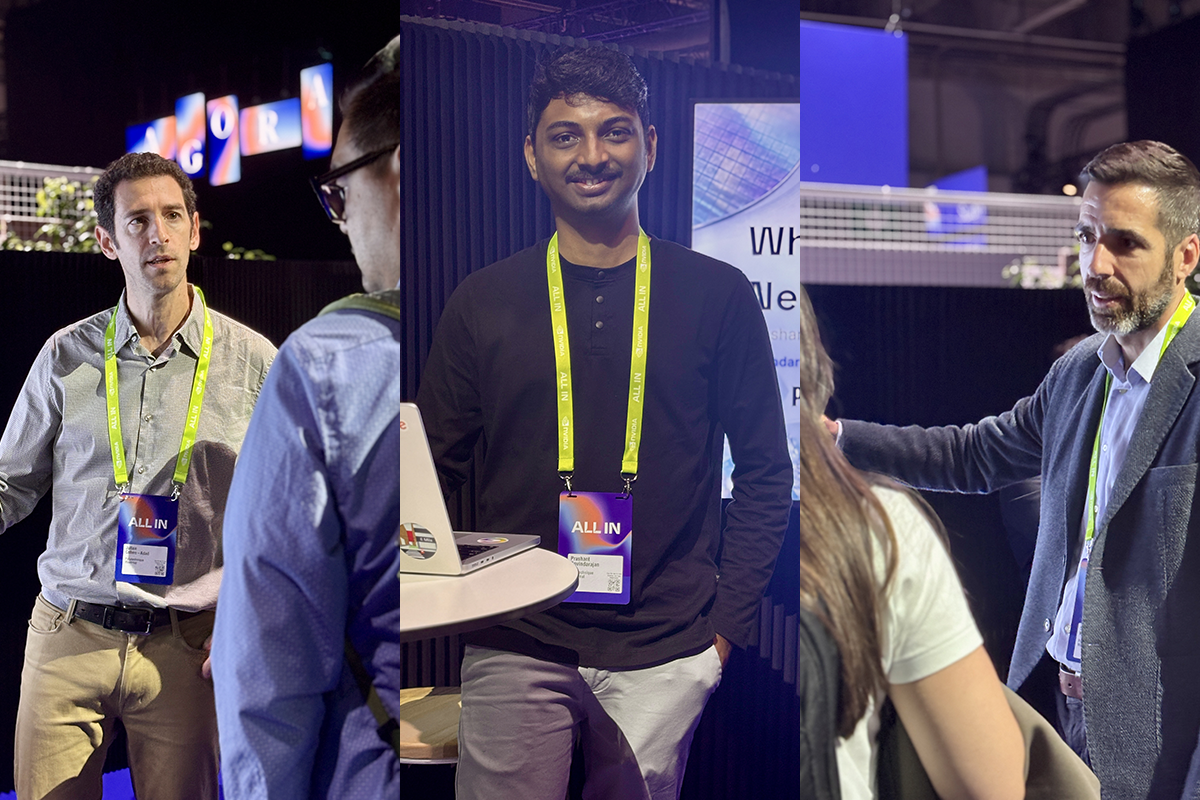
On September 17, the Polytechnique Montréal booth featured the expertise of:
- Julien Cohen-Adad, Full Professor at our Department of Electrical Engineering. He is specialized in medical imaging, neuroimaging, and clinical AI (left picture);
- Stéphane Kéna-Cohen, Full Professor in the Department of Engineering Physics. Stéphane is an expert in AI for advanced materials and photonics (right picture);
- Prashant Govindarajan, PhD candidate in Computer and Software Engineering (centre picture). He is working on AI for materials science, large language models, and reinforcement learning and collaborates with Sarath Chandar, Associate Professor within our Department of Computer and Software Engineering.
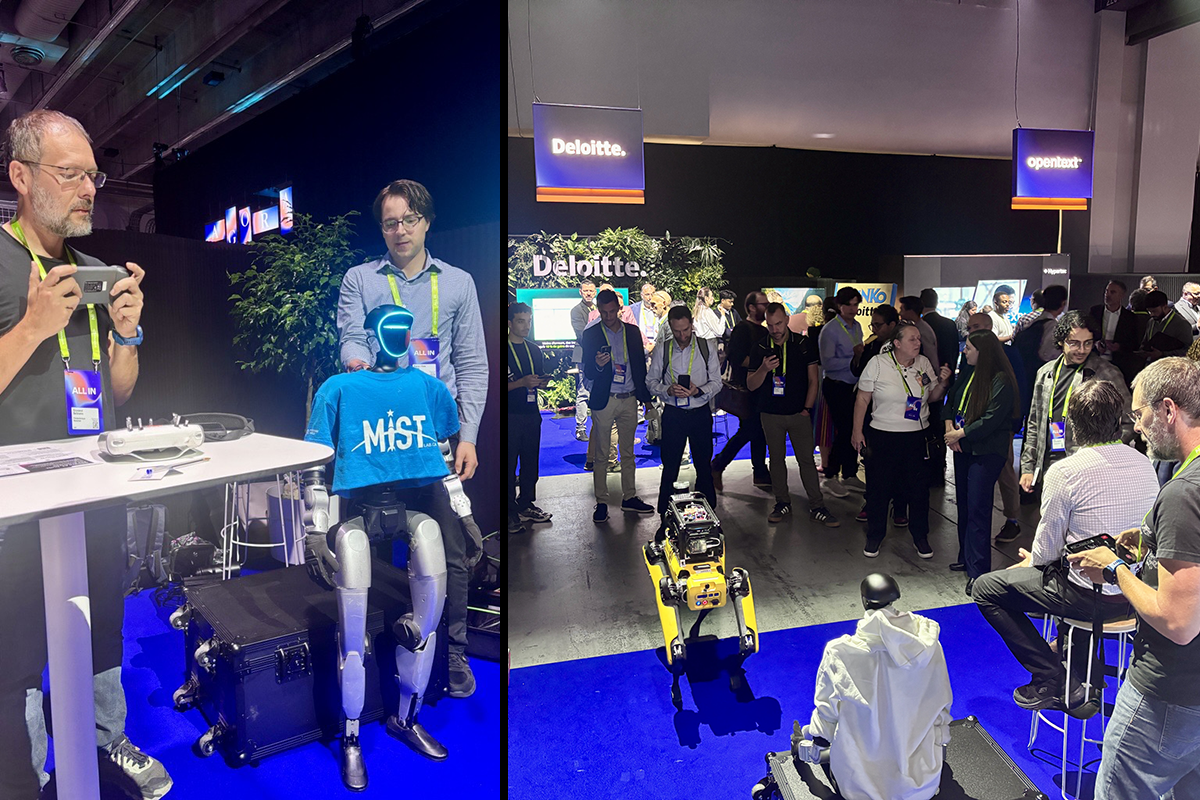
Professors Giovanni Beltrame, Full Professor at our Department of Computer and Software Engineering (left in the left picture), and Pierre-Yves Lajoie, Assistant Professor in the same department (right in the left picture), also presented their quadruped and humanoid robots, along with their robotics research.
The robots, which proved highly popular among visitors, helped make the concepts discussed at the booth more tangible and accessible for the participants of the conference.
“How do we make AI work reliably in the real world?” asked Foutse Khomh from the ALL IN stage. In the face of this new AI revolution, Polytechnique is committed to advancing AI in service of society: designing it, making it trustworthy, deploying it responsibly, training those who will shape its future, and contributing to its governance. “Because the next revolution in AI won’t just be written in code. It will be engineered.”
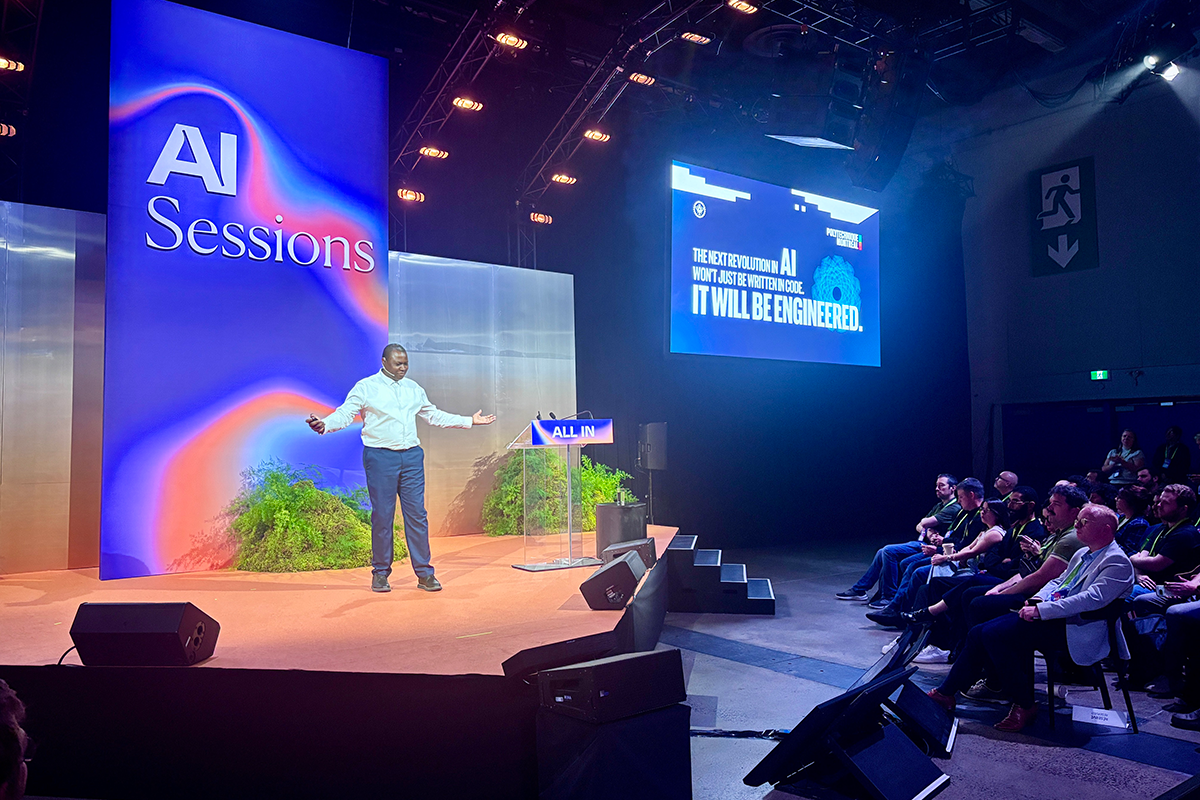
Foutse Khomh on the AI Sessions Stage.
Learn more by visiting the AI for the Real World website, watching videos featuring our experts to explore our university's three action areas initiative, and discovering Polytechnique Montréal’s commitments for the AI of tomorrow.