

Medical equipment, medical supplies
Unmet need
Understanding capillary‑level blood flow is essential for advancing diagnostics and treatments in neurodegeneration, aging, and stroke. Yet existing imaging technologies all face the same limitation: they cannot capture single‑capillary dynamics deep within intact organs. Optical methods offer high resolution but are invasive and shallow, while MRI and micro‑CT reach deeper but lack the precision needed for microvascular analysis. Ultrasound promises scalability and deeper penetration, but current systems struggle with diffraction limits, skull-induced distortions, and the extremely slow blood flow characteristic of capillaries. Accurately measuring capillary transit times, stalling events, and microvascular health could transform early detection of neuroinflammation, stroke, and neurodegenerative disease. There is a major need for scalable technology capable of delivering true microcapillary‑level functional imaging across whole organs.
Technology overview
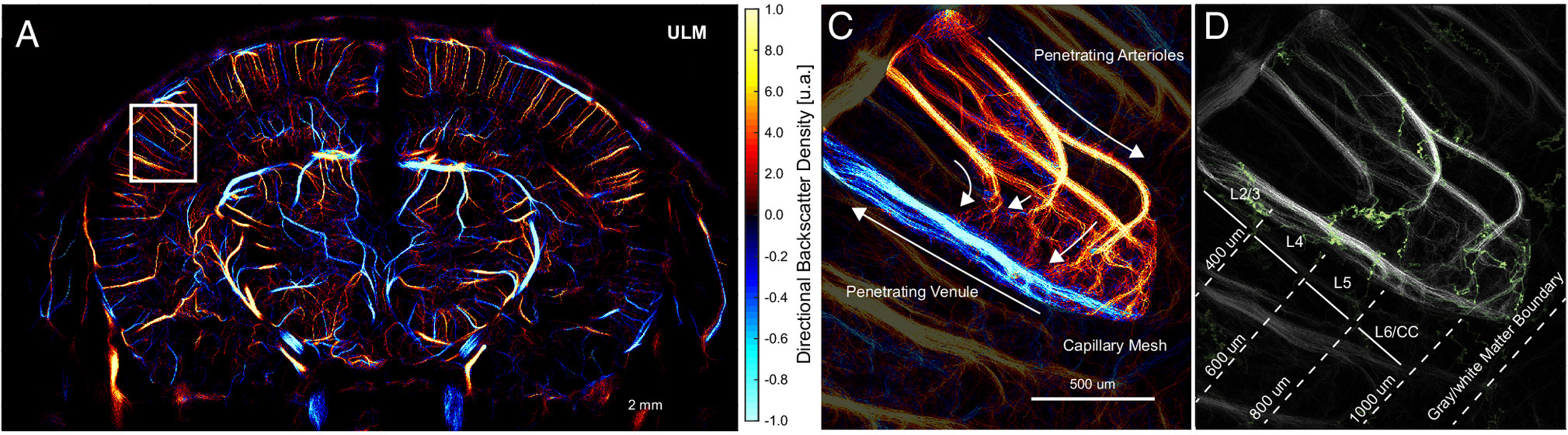
This invention introduces Single Capillary Reporters (SCaRe), a breakthrough ultrasound localization microscopy (ULM) system that non‑invasively maps and measures single‑capillary function deep within whole organs, including the brain. SCaRe combines high‑frame‑rate ultrasound with microbubble contrast agents and continuous data acquisition. It processes thousands of frames to isolate ultra‑slow microbubble flows that conventional ultrasound processing suppresses. Advanced spatiotemporal tracking and statistical modeling extract key functional biomarkers, such as capillary dwell times, stall events, and velocity profiles, producing integrated super‑resolution maps for both structure and function. Unlike optical imaging, MRI, or standard ULM approaches, which all compromise between resolution and penetration depth, SCaRe uniquely recovers slow flows and enables transcranial, single‑capillary functional imaging using existing clinical hardware.
Market applications
- Stroke treatment and recovery monitoring
- Early neurodegenerative disease diagnosis
- Detecting systemic inflammation impacts
- Whole organ microvascular functional mapping
Competitive advantage
- Non-invasive deep-tissue imaging with capillary resolution
- Micron‑scale detail beyond conventional ultrasound limits
- Reliable detection of ultra-slow blood dynamics for key microvascular biomarkers
Business opportunity
- Looking to license the technology

Prof. Jean Provost
Full Professor
Department of Engineering Physics
Expertise
Sarah Nahlé
Technology Transfer Manager
