

Medical imaging, Life sciences, Medical equipment
Unmet need
Multi-hyperspectral imaging is an emerging technology impacting healthcare, agriculture, environmental monitoring, and industrial inspection. By capturing a broad spectrum of light at each pixel, it enables precise identification of materials, tissues, and biological structures. In biomedical diagnostics, hyperspectral microscopy can reveal subtle biomarkers and cellular features invisible to conventional imaging. Despite its promise, current systems remain limited by high cost, bulky hardware, and poor adaptability. Most commercial platforms rely on pushbroom scanning, which is poorly suited for microscopy or moving biological samples. Wide-field systems are better for biological imaging but remain rare, expensive, and difficult to integrate into standard microscopes. Existing solutions are also largely limited to transmission or reflection modes, while advanced techniques such as dark-field hyperspectral microscopy remain scarce. Consequently, there is a strong need for accessible, miniaturized, and cost-effective wide-field hyperspectral technologies compatible with conventional microscopes.
Technology overview
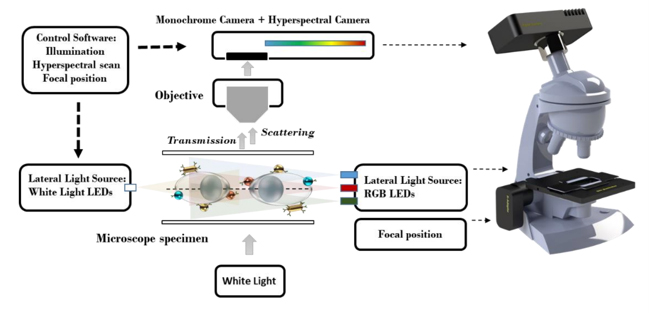
This technology is a modular, cost-effective multi-hyperspectral microscopy platform designed to upgrade existing microscopes with advanced spectral imaging capabilities. It combines advanced cameras, a controllable spectral filter, and LED illumination to enable high-resolution, 3D imaging and precise material or biomedical analysis, while remaining compatible with standard microscopes and multiple imaging modes. The system enables fast wide-field hyperspectral imaging in bright-field, fluorescence, and dark-field modalities. It offers an affordable and versatile alternative to conventional pushbroom hyperspectral systems, with rapid manual or automated spectral tuning and seamless switching between monochrome and hyperspectral modes. A key advantage is precise high-contrast dark-field imaging at high magnification and accurate imaging of moving samples, live cells, and nanoprobes. The platform also supports real-time tracking and multiplexed bioimaging, expanding access to advanced hyperspectral microscopy for research, diagnostics, and material analysis. It delivers high performance and flexibility at low cost.
Market applications
- Digital and virtual histopathological staining
- Biomedical research and drug development
- Agriculture and environmental monitoring
Competitive advantage
- Cost-effective and modular design with versatile imaging modalities
- Fast and flexible spectral tuning with real-time tracking
- Enhanced biomedical microscopy with advanced diagnostic capabilities
Business opportunity
- Looking to license the technology

Prof. Michel Meunier
Full Professor
Department of Physics Engineering
Expertise
Sarah Nahlé
Technology Transfer Manager
