
Nouvelles
A photonics breakthrough that could rein in AI’s growing energy demand
A team at Polytechnique Montréal has opened the door to a new generation of photonic chips that could cut the electricity use of data centres and generative AI systems. The work is published today in Science Advances, part of the Science family of journals.
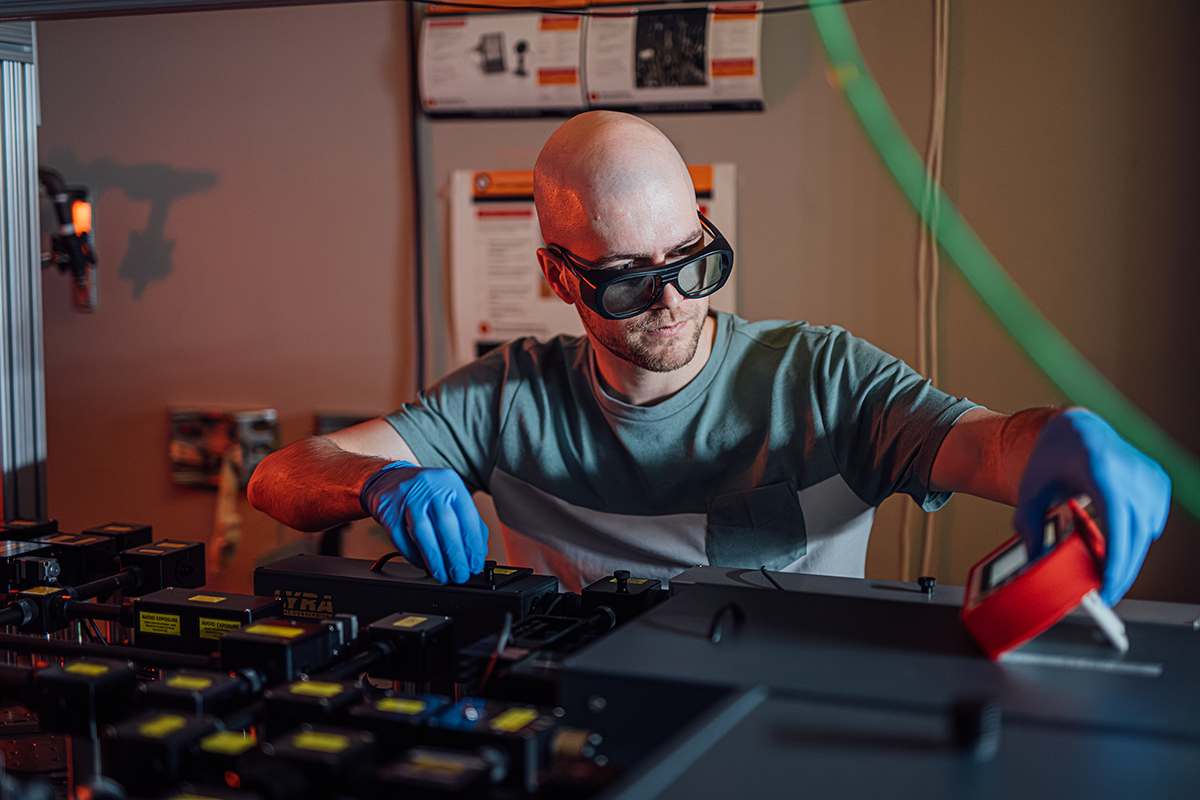
Pierre‑Luc Thériault, a PhD student in Engineering Physics and first author of the study, aligns an experimental setup used as part of this study. (Photo: Caroline Perron).
Every second, the data behind billions of emails, TikTok videos and AI queries travels around the world as pulses of light through fibre‑optic networks.
Along the way, these signals pass through tiny components that act as channels for light: photonic chips. These devices don’t just carry signals—they direct and combine them, ensuring information moves efficiently across complex networks.
But photonic chips still have limits. They struggle to perform certain key light‑processing operations. Tasks such as signal conversion and amplification still rely on additional components—components that are bulky, consume energy and generate heat.
AI is creating new demands
Today, the energy footprint of these components remains relatively small, accounting for only a few percent of a data centre’s total electricity use. But generative AI is already starting to change that equation.
Unlike a simple search query, generative AI systems depend on constant back‑and‑forth exchanges between processors. Each exchange increases the number of times signals must be converted and reshaped. What was once a minor cost is becoming a structural challenge—and one that could limit how far AI systems can scale.
Without changes, that trend could drive a rapid—and potentially unsustainable—rise in the energy use of digital infrastructure, which already represents about 2% of global electricity consumption.
A team led by engineering physics professor Stéphane Kéna‑Cohen at Polytechnique Montréal believes it may have found a way forward. Their results appear today in Science Advances.

Professor Stéphane Kéna-Cohen. (Photo: Sarah Latulippe)
Puttint light to work
The team has identified a new material that can be integrated directly onto silicon, enabling it to carry out advanced optical functions. Instead of converting back and forth between electrical and photonic signals, the material allows light to be processed directly.
The breakthrough hinges on an organic molecule designed to strongly interact with light, known as triphenylamine–dicyanoquinoxaline, or simply TPA‑QCN. This material shows a second-order optical nonlinear response — a property that allows light beams to interact as they travel through the material, opening the door to functions such as amplification and modulation directly on-chip.
Deposited as a thin film through vacuum evaporation, the material forms a layer in which the molecules no longer behave randomly, but instead adopt a preferred orientation.
“This spontaneous alignment may sound like a small detail, but physically it makes all the difference,” says Stéphane Kéna‑Cohen. “It gives the material the ability to manipulate light in ways that simply aren’t possible with today’s silicon photonic chips.”
Just as importantly, the material is compatible with existing manufacturing processes used in the photonics industry. “We can now realistically envision integrating new functions directly onto photonic chips,” says Pierre‑Luc Thériault, the study’s lead author. “And we can do it at low temperature and low cost, using processes that are already standard in the industry.”
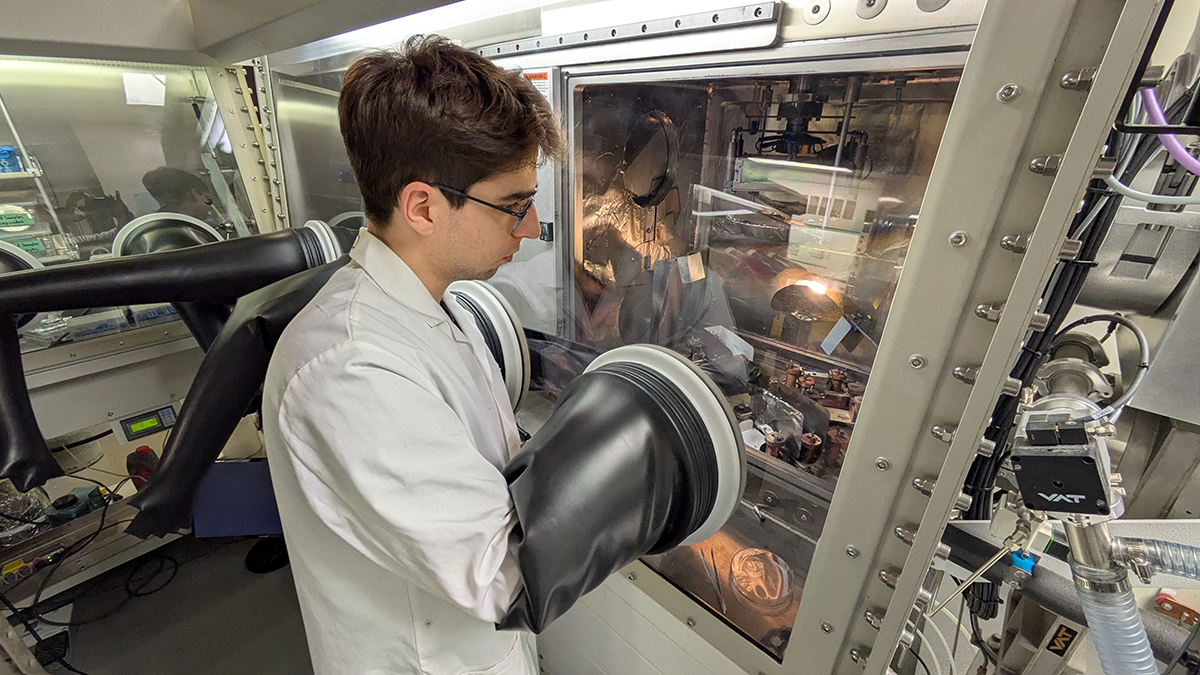
Arnaud Petit, a PhD student and co‑author of the study, prepares a sample on which a thin organic film will be deposited using vacuum thermal evaporation. (Photo: Martin Primeau)
To demonstrate the concept, the researchers designed an integrated device capable of converting infrared light used for telecommunications into visible red light directly on the chip. It’s a proof of principle—but already an encouraging one.
“We’re already seeing improved performance using better performing variants of these self‑aligning molecules,” Kéna‑Cohen adds.
The approach opens the door to a new generation of optical components—including modulators, amplifiers and specialized light sources for quantum technologies—used to encode information, boost signals and generate tailored forms of light.
“If we can combine these functions on a single chip, we simplify everything,” says Kéna‑Cohen. “Fewer conversion steps, less heat, and systems that are better suited for what’s coming.”
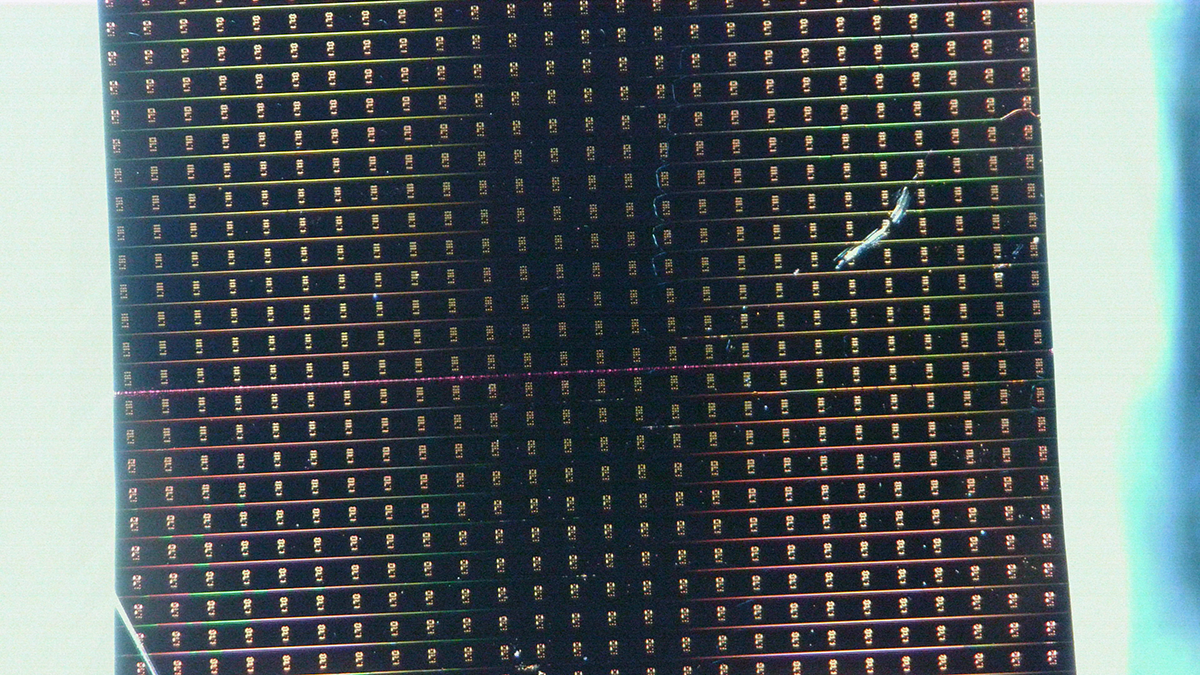
The researchers used waveguides—microscopic channels fabricated on a silicon wafer—to guide light. Long waveguides of varying widths can be seen on the chip, where a thin layer of organic molecules transforms light as it passes through (Photo: Pierre‑Luc Thériault)
Recent advances in AI hardware, such as Google’s TPU 8t and 8i chips, illustrate how computing architectures are rapidly evolving. By dramatically increasing the exchanges of data between processors, these systems are making the movement of information—much of it carried as light—a growing energy bottleneck in modern data centres.
In that context, advances in integrated photonics like those developed at Polytechnique Montréal could prove critical—not by replacing electronics, but by giving light a larger role in how data is processed, and helping sustain the next wave of AI at scale.
Learn more
Article published in Science Advances
Expertise profile of Professor Stéphane Kéna-Cohen
Department of Engineering Physics website